





Introduction: Why Psychology Is Becoming Football Betting’s Biggest Advantage
Football betting has evolved drastically in the past decade. Gone are those day that bettors use to relied solely on televisiony pundits, newspapers predictions or the gut feeling or emotion before playing their bet. In 2026 the landscape of football betting is more competitive than it has ever been. With the rising of Advances Artificial intelligence (AI), machine learning algorithms, expected goals (xG) models, player performance analytics, and real-time injury tracking updates that is available to almost everyone thanks to the internet connection.
Today, thousands of bettors all over the world can access the same match statistics within seconds. They can even compare odds across various bookmakers, review their head to head records, analyze the game possession data, study expected goals, as even go as far as receiving AI generated match predictions before the game starts. The one thing that use to separate the casual bettors from the experienced bettors with was information, is now available everywhere breaking the gap and making the gap much smaller.
If you’re to look at it closely, one will say that it an advantage that more information is now available to everyone and could lead to a better betting decision. However, the reality is far from that.
Despite the fact that we now have more access to data and ever before, a large number of football bettors still lose more in the long run. The reason is not the availability of good prediction tips or the lack of necessaries statistics, but it always about the poor decision making of the bettors that more often driven by emotion or their support for a certain team or thinking because it a big side that has been winning their previous games, so they won’t lose without proper analysis.
Think about this. Two bettors can study the exact same match, use the same statistics and even agree that one team has a 65% chance of winning based on probability. Yet one bettors will stick to the plan and play a good bet on the team to win while the other can abandon the strategy because of what he hear or see on social media, or even change the bet at the last minute before kickoff because of panic. when they lost, they will now increase their bankroll to win back their lost which would in turn make them make irresponsible decisions. If you look at it, the data remained the same but the mindset that changes everything. This is where psychology becomes the real game changer.
If we say that everyone has access to the same statistics, the same AI tools, and the same prediction models, what separates consistently successful bettors from everyone else?
The answer is mental discipline.
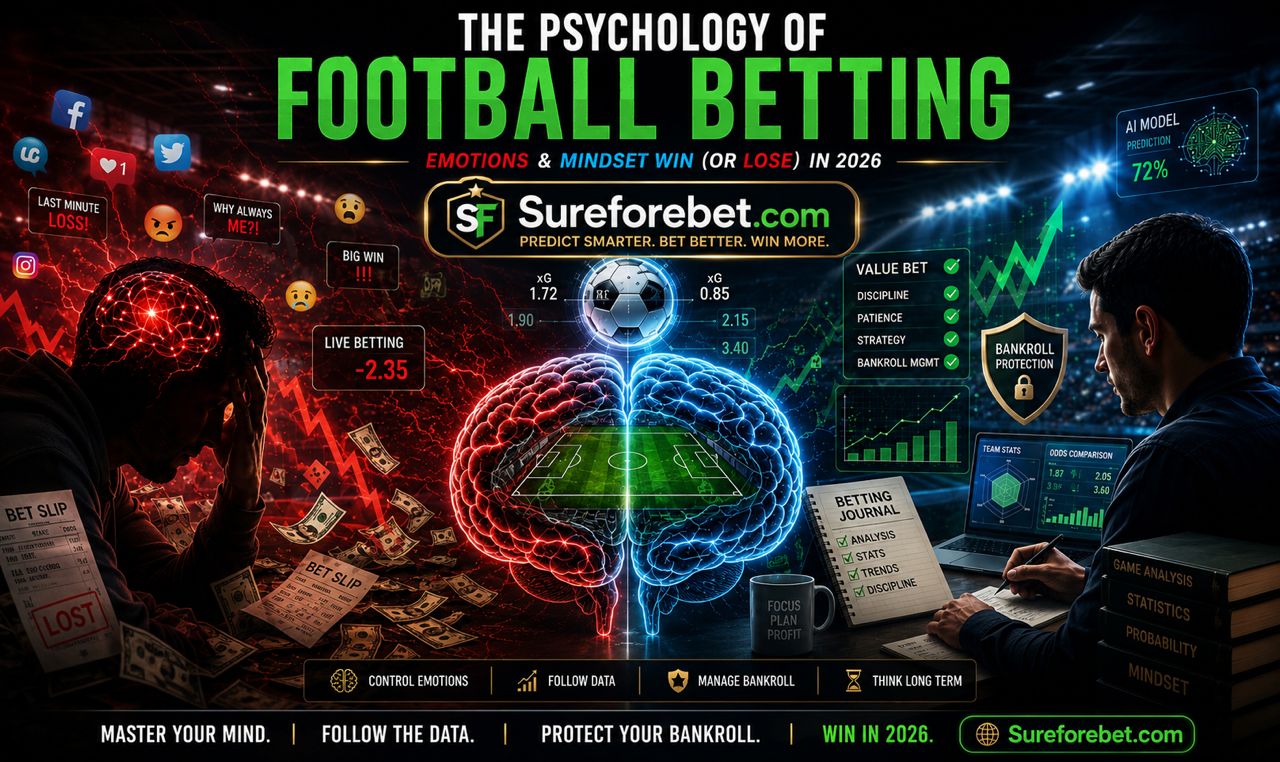
A Successful football betting isn’t just about finding who’s going to be the winner in the game. It about making rational decisions consistently, managing your emotions during a winning and losing streaks, protecting your bankroll, and staying focused and committed to a proven plan instead of running after short term outcomes or unrealistic claims.
At Sureforebet, we believe that football betting is very much a psychological challenge as it is a statistical one. While quality analysis, well details probability chart and accurate predictions remain very much important to us, your ability to stay disciplined during moments of excitement, disappointment, or uncertainty will often determines your long-term success.
In this guide, you’ll discover how the human brain influences betting decisions, the most common psychological traps that affect football bettors, practical techniques to improve your mindset, and daily habits that help experienced bettors remain consistent in an increasingly competitive betting environment.
The Science Behind Football Betting Decisions
Many people believe football betting is something you analyze logically. But in reality every betting decision you make involves analytical thinking and emotion processing.
Which is why Whenever you place a bet, your brain begins to evaluate the possible rewards. If the potential outcome looks attractive and certain, it activates the brain’s reward system by releasing dopamine which is a neurotransmitter associated with motivation, pleasure, and anticipation.
Interestingly, dopamine is released not only after winning the bet but also while expecting a possible win that you’re certain to win. This explains why placing a bet often feels exciting even before the match begins and you’re always confident that the game will play.
Imagine predicting that an underdog will win the game with a very attractive odds. Even before the match kickoff, your brain will start anticipating the possibility of you winning a huge sum of money. This anticipation is what creates excitement and the confidence you get before the game starts
When the prediction now wins, that dopamine now reinforces that behavior, in turn encourages you to repeat the same action in the future or more after the win.
It best to know that the same reward system can work against you as a bettors because supposing you correctly backed France to defeat Brazil at odds of 2.10 after a detailed analysis. The unexpected success that you just had can create a strong emotional response, Without you realizing it. your brain may now begin to associate your recent success with personal skills rather than acknowledging that football is an uncertain game and something can just happen that will change the outcome of the game. For example a sudden red card or a top striker getting an injury during the game.
Your brain linking the old success can lead to over confidence, you Making larger stakes, and unnecessary risk on your future bets.
At the same time, unexpected losses can activate emotional weakness that can lead to frustration and disappointment. If something like this happens, most bettors respond is to place another bet immediately in other to try and win back their loss. But it smart to know that behavior is known as you chasing losses and it not good in any way. Because any emotional decision you take immediately after a loss rarely follows proper analysis and in most cases results in an even greater losses.
Behavioural economics and sports psychology consistently show that one’s emotions influence their financial decisions far more than they could ever imagine. And football betting is not excepted.
It smart to Understand how your brain naturally reacts to winning, losing, and uncertainty and this is the first step towards achieving a more rational betting decisions.
Professional bettors don’t just eliminate their emotions, instead they learn to recognize them, manage them, and prevent them from controlling their actions moving forward.
The ability to do that accurately often becomes their biggest competitive disadvantage over the casual bettors.
Why Emotional Control Is More Valuable Than Perfect Predictions
Every football match contains uncertainty and no predictions is 100% guaranteed, because of unplanned outcomes like A red card in the 15th minute, A missed penalty, A controversial VAR decision, An injury during warm-up even the best predictive strategy can not totally account for everything that is going to happen in the game.
This means no betting strategy can eliminate losing bets completely.
What separates a disciplined bettors is not the ability to achieve a perfect win rate, but how the response when the odds don’t go their way. Instead of reacting emotionally after every outcome, experienced bettors calm down and evaluate if their decision making was don’t in the right way.
If the analysis was done right and the outcome didn’t favor them then they move on. But if the decision they took ignores some important information or was influenced by their emotions, then they make sure they identify the mistake and improve their mindset.
Over Time, following a process that focuses on producing a greater mindset everytime is better than just going after the short term wins.
In modern football betting, your greatest advantage as a bettors is not betting prediction rather it you having control over your emotions.
Common Psychological Biases That Cost Football Bettors Money
Understanding football statistics is very important, but understanding how you mind works and play strikes is also valuable because the human brain is dealing to make quick decisions and they often used mental shortcuts that we know as cognitive biases. While the shortcuts can be useful in your everyday life, it can frequently lead to poor betting decisions because of it nature.
Below are ten of the most common psychological biases that affect football bettors in 2026 onwards, along with practical ways to avoid them.
1. Confirmation Bias
What is confirmation bias:
confirmation bias is when you are looking for more information that totally supports your opinion and at the same time that totally ignore the fact that there’s an evidence that may contradict your opinions.
Football example:
You believing that Arsenal are going to win their game comfortably because they have won their last four league games in a role. Instead of checking their injuries reports, fixtures congestion, their opponents home record, motivation of the game, their head to head with this team because a big team can most time loss to a small team every time they meet, but you only read the article, analysis and prediction that agree with your own view and go with your predictions.
How to avoid it:
Before placing a bet, ask yourself this simple question “What are the evidence that suggests this bet could lose?” Then you Look at both sides of the argument that’s you’ve just made and see whichof them is better. Act like this are what can leads to more balanced decisions.
2. Anchoring Bias
What is anchoring bias:
Anchoring bias is when your judgment on a matter is totally over influenced by the first piece of information you see, read or receive from any prediction platform.
Football example:
A certain bookmaker pick Chelsea to win their game with a 1.70 odds. But after some match update and some key players news of missing the game because of last minute injury can in turn shift the odd shift to 2.00. But you as a bettors still believing that Chelsea are a strong favorite to win the game even after the changes because your first impression was that the had all the possible and potential to win the game with a good odd, that’s anchoring bias.
How to avoid it:
It smart to always treat every match as a fresh analysis every time you come across it with. And make sure you update your betting tips whenever a new information is being published about the game.
3. Gambler’s Fallacy
What is gambler’s fallacy:
This is the form of mistaken belief that bettors and gamblers made thinking that the previous outcomes of how the last game was played can influence a future independent game.
Football example:
A team that has failed to win their last five matches consistently, and you now assume because they have not won in the last five games that they are going to win their next game without any analysis but out of the assumption you now think that they’re supposed to win their next match.
It very important to understand that football doesn’t work like that, every single match is influenced by current tactics, availability of players, motivation of the game, many other factors and not assumptions.
How to avoid it:
Base your betting decisions on the match available probabilities chart of both sides and performance metrics rather than believing that their luck must eventually come because they’ve lost enough.
4. Sunk Cost Fallacy
What is sunk cost fallacy:
This is when you person choose to continue with a poor decision just because you’ve already invested your money or emotions into it.
Football example:
You’ve lost three bets in a roll because you’re using particular betting strategy. Instead of rethinking your approach or reanalyze if the strategy still has value, you just choose go on using it because you feel like you’ve already invested you time and money into it.
How to avoid it:
It better to Judge every betting decision that you take personally. And always remember that just because you lose to last bet, that shouldn’t be the reason you take another future risks.
5. Availability Bias
What is available bias:
This when one give too much importance and attention to information all because it easiest to remember.
Football example:
Ronaldo scoring a brace against a mid side Uzbekistan from their second group stage match. Because of that moment was fresh in your mind you now over estimate Ronaldo current form while ignoring the months of him not performing at all in the league and previous game. Then he didn’t perform on their last game against Colombia.
How to avoid it:
Look beyond recent highlights, noise and fan claims. Because it better to judge a team the full picture because if you look deeper into statistics, it always tell the full story about the team.
6. Loss Aversion
What is loss aversion:
Psychological studies have suggest that as humans, we generally feel more pain when we lose something than the pleasure we get when we win something.
Football example:
After you have just lose $20,000 on an accumulator, then you quickly place another high risk bet without proper analysis in the hope that you’re going win your money back. But unfortunately, this kind of emotional response often creates a more larger losses that you could never imagined.
How to avoid it:
It smart to always set a daily or weekly limit on the amount of time you’re supposed to lose in a day. Once you’ve reached that number, you will be disciplined to stop for the day and come back another day and bet when our head is more clear.
7. Herd Mentality
What is herd mentality:
This is the act of a bettors Following what the crowd has been saying about a certain team to win rather than trust your own analysis.
Football example:
In the 2026 World Cup Thousands of people on Telegram page, TikTok, or X are supporting Spain to win the tournament because of their squad depth and young talents. Then as a bettor, you now see that and you now decide to follow them public opinion Without carrying out your own research. This is when a bettor just follow the majority voice simply because he thinks the everyone can’t be wrong and the crowd see something that he or she doesn’t.
But In reality, the betting markets often overvalue any odds that they see that many people are betting on and it seem to be popular and all this happens based on public opinion.
How to avoid it:
It very important to always carry out your personal analysis because looking for external information to support your analysis.
8. Optimism Bias
What is optimism bias:
This is when one Believes that a positive outcomes is more likely to go your way than they are really are.
Football example:
You consistently expect your favourite club to over perform even when all data show that they are not the favorites to win the game.
Supporting a team emotionally and betting on your favorite team to win a game can cloud your objective judgment even when you know that the analysis doesn’t favor them.
How to avoid it:
It smart to always try and make sure you avoiding bets that involve your favourite club playing against any team both strong or weak. Your Emotional attachment to a certain club can make following a certain analysis difficult for you.
9. Outcome Bias
What is outcome bias:
This is when you Judge the quality of a decision solely by the final result.
Football example:
You place a poorly researched bet for a weak side to and the eventually wins because of a late own goal. Instead of you to recognize that your decision was weak, you assume your analysis was excellent.
In the same sense, a well researched bet can still lose because of an unfortunate red card, but that happening doesn’t necessarily make the analysis a bad decision.
How to avoid it:
Always Evaluate your reasoning every game rather than the final score. It best you understand that a Good decisions can lose, and poor decisions can sometimes win.
10. Illusion of Control
What is illusion of control:
This is when Believe that you have more influence over the outcome of the game more than you actually do. It may be because you feel your analysis way right or your probability was higher that the one given by the bookmakers.
Football example:
This usually happens After you’ve won several bet in a row and you begin to believe that you have already figured out how the market works and that will in turn make you to now increase your stakes.
The important part that you should always have in mind is that football always contains uncertainty and no analysis or models can accurately guarantee a 100% win rating.
How to avoid it:
Respect probability. Your Confidence should come from consistent analysis, not recent results.
Real Football Example: The Danger of Chasing Losses
Imagine you backed France to beat Brazil with 2.10 odds and after you spent minutes if not hours to analyze team new, expected goals (xG), recent performances, and tactical matchups.
And to you everything looks certain and positive, them on the final 95minute Brazil see the net and get a dramatic win.
Naturally, you’ll become frustrated and that’s how everyone will feel.
But instead of accepting that a well researched and analytical bet can still sometimes lose, you immediately notice that another game is starting in the next 20 min. without carrying out proper analysis, you rush and stake in the hope that you’re going to recover the money that you lose earlier.
If you look at it closely, you will see gat this second bet is not based on value but instead it based on emotion.
This are the kind of moments professional bettors recognize and that know that they are in an emotional state and that deliberately avoid placing another bet on any game until they know that they are thinking clearly.
It important to understand that one disciplined decision that most time save your whole week bankroll.
Why Emotional Control Protects Your Bankroll
A bankroll is more than just money that a bettors set aside for betting, but it’s the foundation of long-term success. Even if you have the best prediction strategy , you can fail if you make a poor emotional decisions and that can lead to reckless staking.
One of the biggest mistakes casual bettors make is by increasing their stakes after a loss or becoming overconfident after a win. Both reactions are carry out by emotion rather than logic.
Experienced bettors approach staking with discipline.
Use Unit Staking
Rather than betting random amounts on any given bet, many professionals use a unit system.
For example, if one unit equals 1% of your bankroll, every standard bet carries the same level of financial risk regardless of confidence that you have in the bet.
This approach protects your bankroll during inevitable losing periods.
Percentage Staking
Some bettors prefer to risk between 1% and 3% of their bankroll on each each game that they picked.
Have it in mind that As the bankroll grows, stake sizes increase naturally.
If the bankroll falls, stakes should decrease automatically, this can help reduce the risk of large drawdowns.
Never Double Stakes After Losing
Doubling your next bet after a loss may feel like a quick way to recovery your fund or a better strategy, but mathematically it exposes your bankroll to unnecessary risk.
Every bet that you’re are going to stake should stand on its own merits, not on what happened previously.
Think Long-Term
Professional bettors understand that profitability is measured over hundreds, that is to say that it takes time to accumulate the money and it not done with a single bet but rather with a whole week bet.
A disciplined bankroll strategy allows you to survive any short term losing streak that you may experience in your way and it give you an advantage and enough time to consistently produce long term results.
In all sense, it important to always know that protecting your bankroll start with you protecting your emotions. When your emotions is under control and in check, you begin to think of better financial decisions and it flow naturally.
Winning Streaks, Losing Streaks, and the Psychology of Variance
There’s this misconception that everything in the football universe believes, and that is that a winning streak mean that to have finally figured out how the market works and a losing streak mean that your strategy no longer works.
But the truth that they seem to forget is that football betting is built on probability, and not certainty.
Even an experienced bettors that has been winning for a long time can still experience a sudden losing runs. And the same goes for for the inexperienced bettor that can enjoy a series of some lucky wins. This is the point where understanding the essential things about football betting like variance is very important.
Variance is just a natural process where you can win or lose more than you every expected, even when you’re following the right betting strategy. Because football as we all know can be influenced by different unpredictable factors like injuries, refereeing decisions, weather, tactical changes, red card, emotional issues from players, and moments of brilliance. So if you’re getting a short term result, then you’re not seeing all that football can mean.
Another important concept about football is regression to the mean. That’s If a team has been performing very well or poorly than the level it expects, the result that you would be getting is closer to their average performance as time goes by. Thing like this doesn’t happen because football owes the team that particular result, but because extreme outcomes like that are difficult to maintain in the long run.
Instead of asking, “Am I on a hot streak?” ask yourself:
– Did I follow my betting strategy?
– Did I identify value in the odds?
– Would I place the same bet again with the same information?
If after asking all these questions and the answer is still yes, then you are focusing on the process of getting a better understanding of the match rather than the outcome of the game and these is the kind of mindset that disciplined bettors should have.
Cognitive Fatigue: Why Tired Minds Make Poor Bets
As it is, many bettors spend more time studying statistics, comparing different odds, and watching more matches to understand the game play of each team. But while preparing is very important, you not finding time to rest enough can also lead to decision fatigue, this is a psychological state where the quality of the choices you make over time gradually decreases.
Think about a typical working class person evening. You work all day, come home and still deal with the normal house shores and family responsibilities, and then sit down at 11:00 pm to bet on a late night or early hour match. At the time of the day, your brain is already mentally exhausted.
In such state, you’re more likely to:
– Ignore important statistics.
– Accept poor odds without comparison.
– Place impulsive accumulator bets.
– Follow social media tips without proper verification.
– Chase earlier losses.
Which is the why Professional bettors tend to understand that their mental condition can most often affect their performance in betting just as much as their analytical ability.
If you’re in a state of mine where you’re frustrated, tired, distracted or emotionally upset, it best that you totally skip betting at the moment until you get to the right mindset. Missing one day opportunity to win is far less costly than making several poor decisions because your judgment was done in the right state of mind.
How Social Media Influences Betting Decisions
Social media has totally changed the way football bettors consume information. Platform like telegram, TikTok, YouTube, X and other betting communities like Whatapp can all provide instant access to predictions, betting codes and guaranteed tips.
But while these platforms can sometimes provide useful insights, they can also create a powerful psychological pressure.
Because every day, bettors are always exposed to screenshots of bet showing them winning massively, long accumulator successes and more often claims of 100% sure predictions. What they don’t bring to the public is the numerous losses that being swept under the carpet and are never posted to the general public.
This is the kind of unrealistic perception that suggests that everyone else is winning and your are the one failing behind.
As a result of that, many bettors:
– Increase their stakes unnecessarily.
– Copy unfamiliar betting strategies.
– Place bets without carrying out independent research.
– Feel pressured to gamble more frequently.
But the fact is to Remember that social media only shows you the part where they succeed and not the part where they fail.
Which is smart to use online opinion as one of the sources of information in your analysis and not as the main foundation behind your betting decision.
AI Can Predict Matches—But It Cannot Control Your Emotions
Artificial intelligence has come into the football betting world and it one of the biggest developments and it here to stay. Now modern AI systems can analyse enormous amounts of data, including expected goals (xG), player performance, tactical trends, injuries, weather conditions, historical results, and even betting market movements.
All these tools can help you as a bettors identify some patterns that repeat themselves and would be difficult for humans to detect manually.
However, AI has one important limitation. It can calculate probabilities, but it cannot control the emotional decisions made by the person placing the bet.
An AI model may correctly estimate that a team has a probability of 68% chances of winning. But if a bettor increases their stake after their previous loss, that’s ignoring bankroll rules, or changes the bet because of panic if they will win or lose, then the quality of the prediction has become less important than the quality of the decision make by the bettors.
Which is why we always empathize that the future of successful football betting is a combination of you using technology and being disciplined.
You can use AI to improve your analysis, while you use psychology to improve your decision making. When use Together, they can create a stronger foundation for a long term success.
Daily Habits of Disciplined Football Bettors
A Professional bettor would rarely rely on motivation alone. Instead, they are going to build habits that encourage consistency and reduce emotional decision-making.
Some of the most effective daily habits that they practice include:
– Reviewing previous bets to identify strengths and weaknesses.
– Keeping a detailed betting journal with reasons for every wager.
– Comparing odds across multiple bookmakers before placing a bet.
– Following a fixed bankroll management plan.
– Avoiding bets when feeling angry, frustrated, or overly excited.
– Ignoring hype from social media and betting influencers.
– Taking regular breaks to avoid decision fatigue.
– Focusing on long-term profitability rather than daily wins.
– Accepting losses as a normal part of probability.
– Continuously learning about football tactics, statistics, and betting strategy.
Which is why they say that small habits that are repeated consistently can sometimes produce a greater result than you constantly searching for a perfect betting system that doesn’t exist anywhere.
Seven Mistakes That Cost Football Bettors Money
Even experienced bettors can sometimes make exact same mistakes. Recognising them early can save significant money over time.
1. Betting without proper research: This is when as a bettor you fully rely on your instincts instead of the evidence that has been provided, act like this bc a lead to inconsistent results.
2. Chasing losses: This is when a bettor Increasing their stakes after they lost a big bet and these is one of the fastest ways to damage a bankroll.
3. Ignoring bankroll management: Betting too much on a single match can in turn exposes you to many unnecessary risk.
4. Betting on your favourite team: when you’re Emotional attachment to a team, it smart to totally ignore the game because your loved for the team can often clouds objective judgment.
5. Following every tipster: Not every prediction that’s shared online is supported by deep analysis from both experts analysts and AI systems, which is why we’ll recommend that you visit Sureforebet for a hybrid AI plus experts betting tips.
6. Overestimating recent form: a team that has One or two good performances do not alway mean that they’re doing well and that doesn’t reflect the team’s quality.
7. Expecting guaranteed wins: they’re is not nothing like guaranteed wins in football because Football is unpredictable. No prediction method, AI model, or expert analysts can boost of eliminate uncertainty completely from football.
Avoiding all these mistakes won’t still guarantee you a 100% success, but it will significantly improve your chances of making smarter, more consistent betting decisions.
What Research Says About Betting Behaviour
Research in behavioural economics and psychology consistently shows that the human emotion plays a major role in their financial decisions making and sport betting is not excepted.
Studies have found that:
– Many bettors lose money primarily because of poor or lack of bankroll management rather than poor match analysis.
– Emotional betting increases your risk-taking behaviour and can often leads to impulsive decisions.
– People naturally remember their big wins more clearly than the small losses that they always have, which in turn creat an inaccurate perception of long-term performance.
– Keeping a betting journal improves self-awareness and helps reduce repeated mistakes over time.
These findings reinforce an important lesson: successful betting depends as much on emotional discipline as it does on football knowledge.
Frequently Asked Questions
Does psychology really affect football betting?
Yes. Emotions influence how people interpret information, manage risk, respond to wins and losses, and decide how much money to stake. Strong emotional control leads to more consistent decision-making.
Can emotional betting be avoided?
Completely eliminating emotion is unrealistic. However, routines such as bankroll management, betting journals, cooling-off periods, and pre-bet checklists can greatly reduce emotional decision-making.
How do professional bettors stay disciplined?
Most experienced bettors follow strict staking plans, review every bet objectively, keep detailed records, and focus on long-term profitability instead of short-term results.
What is “tilt” in sports betting?
Tilt describes an emotional state—often caused by frustration or overconfidence—in which a bettor abandons their normal strategy and begins making irrational decisions.
Should I bet on my favourite football team?
Many disciplined bettors avoid doing so because emotional attachment can make objective analysis more difficult. If you do bet on your favourite club, follow your usual research process and staking plan.
Can AI remove emotional betting?
No. AI can improve analysis and estimate probabilities, but it cannot stop a bettor from making impulsive decisions. Emotional discipline remains a uniquely human responsibility.
Final Thoughts: Your Biggest Betting Edge Is Your Mindset
In today’s football betting world, information is no longer a scarce resource. Statistics, AI-powered predictions, machine learning models, and expert analysis are available to millions of bettors with just a few clicks.
What truly separates consistent bettors from inconsistent ones is not access to better data—it’s the ability to use that data with patience, discipline, and emotional control.
The biggest advantage in football betting isn’t finding a magical prediction—it’s consistently making rational decisions when others are driven by emotion.
Every bettor experiences wins and losses, but disciplined bettors survive losing streaks, protect their bankroll, and continue improving over time. They judge themselves by the quality of their decisions rather than by the result of a single match.
At Sureforebet, we believe successful football betting starts with informed analysis and is strengthened by the right mindset. Our predictions and insights are designed to support your decision-making, but your greatest asset will always be your discipline.
Master your emotions, trust your process, and let every bet be guided by logic rather than impulse. In the long run, your mindset may become your most valuable betting strategy.
If you found this guide helpful, share it with fellow football fans and let us know in the comments: What betting habit are you working to improve this season? Your experience could inspire our next in-depth guide.